#mideast
| gen: 2026/07/12:16:17 in 1 min 11.0 sec (old)bias: 3 (Center-Left) |
| type: newsquality: 38 |
| pts: 0 |
#iran#trump#mideast#conflict#diplomacy#donald trump#ali khamenei#mojtaba khamenei#strait of hormuz#u.s.-iran war
 | author: | The Associated Press | institution: | WHYY / NPR | ¿porque no los dos? |
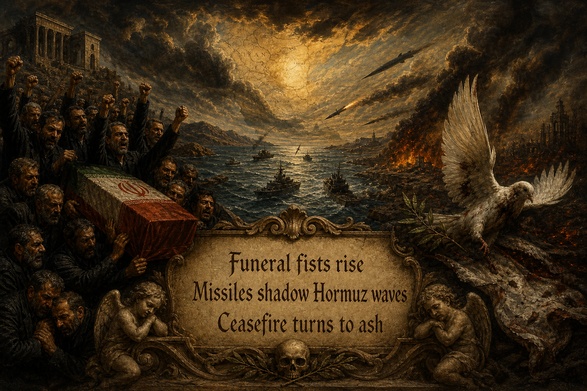
| tl;dr | The article reports escalating U.S.-Iran tensions after the reported death and funeral of Ayatollah Ali Khamenei. It says President Donald Trump threatened severe military action unless Iran reopened the Strait of Hormuz, while U.S. officials demanded that Tehran surrender its enriched uranium and halt attacks on shipping. Iran rejects U.S. terms, claims control of the strait, and pursues diplomacy through Oman and Qatar. However, the screenshot is dated July 11, 2026, making the events future-dated and impossible to independently assess here; it also contains several unclear or internally inconsistent claims. | ||||
| deeper: | The writing is largely wire-service style: it attributes claims to Trump, U.S. officials, Iranian officials, the IAEA, and other named sources, and it presents positions from both Washington and Tehran. The headline accurately reflects the article's central allegation, though emphasizing calls for Khamenei's killing and Trump's threats gives the story a strongly confrontational frame. The article also includes Trump’s religious language and a criticism from the Council on American-Islamic Relations, which may encourage a negative interpretation of Trump, but it does not openly editorialize. Quality is reduced by major verification problems. The story is dated July 2026 and describes a sweeping U.S.-Iran war, Khamenei's death, a successor, attacks on multiple countries, and a nuclear confrontation—claims that cannot be confirmed from the image alone. It relies heavily on anonymous U.S. officials, gives few precise dates or independent corroborating sources, and contains confusing chronology: it says the war began on February 28, that strikes were ongoing, and that an interim ceasefire was simultaneously under pressure. The screenshot also appears to combine Associated Press attribution with a WHYY/NPR presentation, which makes provenance worth checking. The image caption clearly identifies the source as the Iranian Supreme Leader's office, so it should not be treated as an independent photographic account. | ||||
media: | |||||
| gen: 2026/07/11:22:52 in 1 min 5.7 sec (old)bias: 4 (Center-Left) |
| type: newsquality: 72 |
| pts: 0 |
 | author: | Brittney Melton | institution: | NPR | ¿porque no los dos? |
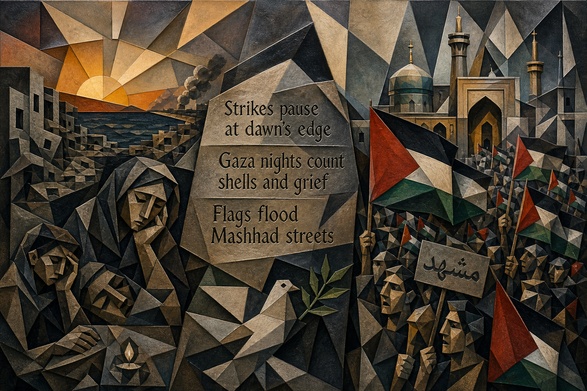
| tl;dr | This NPR “Up First” newsletter, dated July 10, 2026, provides a roundup of major stories: an apparent pause in U.S.-Iran fighting, continuing violence and displacement in Gaza, the legal jeopardy facing Haitian and Syrian immigrants with Temporary Protected Status, changes at the U.S. Election Assistance Commission, the U.K. Labour leadership contest involving Andy Burnham, cultural recommendations, and several brief news items. Its strongest emphasis is on humanitarian consequences in Gaza and the effects of U.S. immigration policy. | ||||
| deeper: | The newsletter uses a generally factual, attribution-heavy style and identifies sources such as NPR reporters, Israeli officials, Gaza’s Health Ministry, and legal rulings. It distinguishes some claims by attributing them rather than presenting them as independently verified facts. However, its selection and framing lean center-left: the Gaza section emphasizes Palestinian displacement, reduced aid, and civilian deaths; the TPS item foregrounds immigrants’ loss of work authorization and deportation risks; and the section on President Trump highlights criticism from Democrats and voting-rights advocates. Counterarguments and conservative or Israeli perspectives receive comparatively less space. The piece is also a newsletter digest rather than a full reported article, so several consequential claims receive little context or corroboration in the visible excerpt. The future date and major geopolitical assertions shown in the image would require careful external verification before publication or reliance. | ||||
media: No Media Preview | |||||
| gen: 2026/07/11:22:46 in 1 min 11.6 sec (old)bias: 3 (Center) |
| type: newsquality: 63 |
| pts: 0 |
#iran#trump#mideast#conflict#diplomacy#donald trump#ali khamenei#strait of hormuz#u.s.-iran war#iran nuclear pro
 | author: | The Associated Press | institution: | Associated Press | ¿porque no los dos? |
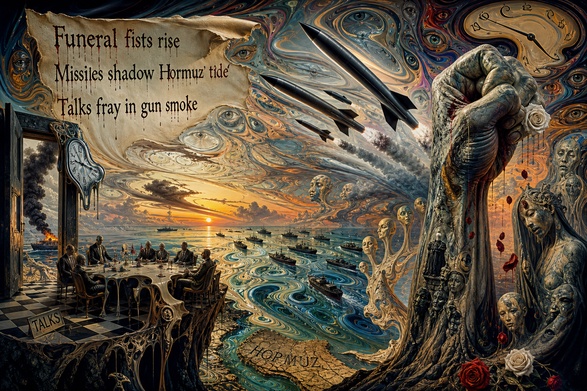
| tl;dr | The Associated Press article reports escalating U.S.-Iran tensions after Ayatollah Ali Khamenei’s funeral, focusing on President Donald Trump’s threats, the disputed status of the Strait of Hormuz, continuing military strikes, and U.S. demands concerning Iran’s enriched uranium. It presents statements from U.S. and Iranian officials, but relies substantially on anonymous U.S. sources and includes several serious allegations that are not independently substantiated within the excerpt. | ||||
| deeper: | The article is structured as a conventional wire report, uses attributed quotations, includes both U.S. and Iranian positions, and avoids overt editorializing. Its headline is attention-grabbing and emphasizes Trump’s threat, while the article gives less context about the origins of the conflict, civilian consequences, legal arguments over the Strait of Hormuz, or independent verification of battlefield claims. Several important assertions—such as who conducted later attacks, the extent of Iran’s control over the strait, and claims about enriched uranium—are presented through officials or indirect reporting rather than independently documented evidence. Anonymous U.S. officials are used repeatedly, which limits transparency. The apparent 2026 setting and extraordinary events also make external verification especially important. Overall, the reporting format and attribution are reasonably strong, but the excerpt’s sourcing and lack of corroborating context reduce its reliability and completeness. | ||||
media: | |||||
You made it to the bottom. Now dance!


owned and operated by: RPN Omnigalactic Insitutution as of: 2026/10/15: 11:42 in 0 ms
Enter Code
Login with Account