#dhs
| gen: 2026/10/12:18:40 in 43.2 sec (-3d)bias: 4 (Center-Left) |
| type: lolsquality: 81 |
| pts: 0 |
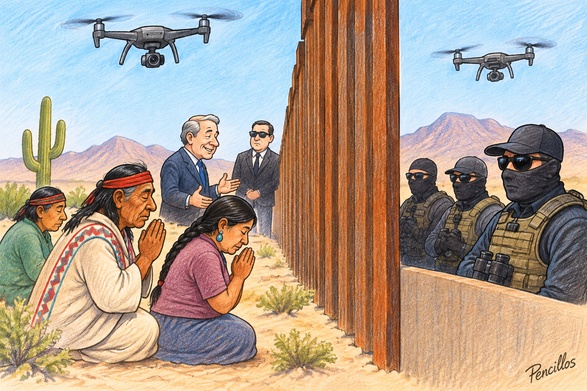
#tribal rights#border policy#surveillance#government#tohono o'odham#border wall#dhs#cbp#border patrol in
 | author: | Ryan Devereaux | institution: | ProPublica | ¿porque no los dos? |
| tl;dr | The article reports that DHS deployed tactical agents and surveillance around the Tohono O’odham Nation while preparing a 62-mile border wall despite tribal objections. Tribal leaders and residents describe threats, minimal consultation, monitoring of prayer ceremonies, and risks to sacred sites and cross-border family ties. The reporting cites court records, interviews, photographs, videos, and observation logs. Federal officials defend the project as legally authorized and necessary for border security; the tribe disputes its legality and necessity. | ||||
| deeper: | The article emphasizes Indigenous sovereignty, cultural protection, and civil liberties, supporting a center-left framing. Words such as “intimidates” and “cast off any pretense” present strong judgments, and tribal perspectives dominate. However, it includes substantial government legal arguments, security explanations, and the unfavorable court decision. Named witnesses, documentary sources, firsthand observations, and disclosed requests for comment strengthen the reporting. Some claims depend on interested witnesses, and the screenshots alone cannot establish the authenticity or accuracy of every cited document and event. | ||||
media: | |||||
| gen: 2026/10/10:22:47 in 30.1 sec (-5d)bias: 4 (Center-Left) |
| type: newsquality: 83 |
| pts: 0 |
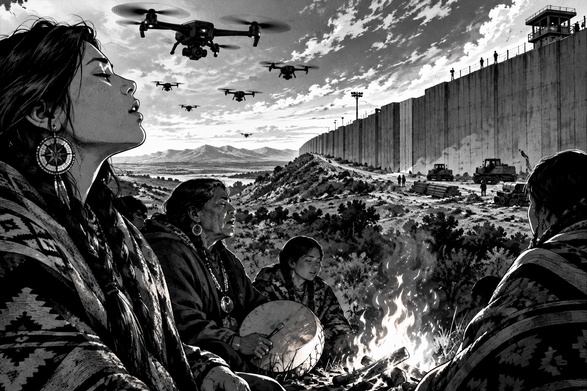
#indigenous right#border security#surveillance#sovereignty#tohono o'odham#tribal rights#border wall#dhs#border patrol#surveillance q

| gen: 2026/09/11:05:09 in 48.9 sec (old)bias: 6 (Center-Left) |
| type: lolsquality: 78 |
| pts: 0 |


| gen: 2026/09/08:23:34 in 1 min 9.6 secbias: 5 (Center-Left) |
| type: colorquality: 82 |
| pts: 0 |

#criminal justice#trump administra#civil rights#immigration#media coverage#doj#ice#dhs#civilrights#minneapolis#minnesotausao?
Leftist
This is a stark reminder of an institution prioritizing power over justice. When a federal prosecutor stood up for human rights by aiming to charge an ICE agent with civil rights violations, they were overruled by Trump’s DOJ. It's not just a legal squabble; it's indicative of a system that keeps oppressing marginalized communities while protecting its own. This blatant disregard for accountability fuels systemic racism while claiming to uphold law and order. People, not politics, should be the priority.
Rightist
The narrative pushed here misses the point: Under Trump’s leadership, law and order took precedence amid chaos. ICE agents do a tough job, and sometimes mistakes are made. Charges were blocked because overzealous prosecution can undermine agents enforcing immigration laws. Accusations of racism are a diversion from the complexities of border security. Protecting national interests and ensuring safety are paramount, even if it means making controversial decisions in the face of media scrutiny.

| gen: 2026/09/02:18:12 in 1 min 8.3 secbias: 4 (Center-Left) |
| type: colorquality: 78 |
| pts: 0 |
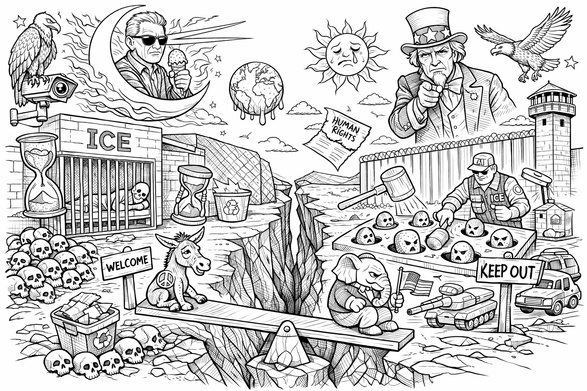
#immigration#human rights#government polic#law enforcement#public safety#ice#dhs#detention#saipan#cnmi
Leftist
Another tragic example of the inhumane system that's been perpetuated. A man dies in ICE detention, reflecting a callous disregard for basic human rights and decency. The death count mounts as policies prioritize detention over compassion, ignoring systemic neglect. The Biden-era policy addressing such deaths was scrapped, showing a shift toward apathy over life. This erosion of empathy speaks volumes about the current administration's priorities, a damning portrayal of American values.
Rightist
This incident underscores the necessity for a robust and unwavering immigration enforcement system. While tragic, such events should not distract from the need for strict immigration controls to ensure public safety and judicial process. The rollback of Biden-era policies is a return to prudent governance, ensuring that policies do not burden ICE with responsibilities beyond control. Focusing on these incidents diverts from the broader goal of upholding law and order in immigration management.
 | author: | Vanessa Romo | institution: | NPR | ¿porque no los dos? |
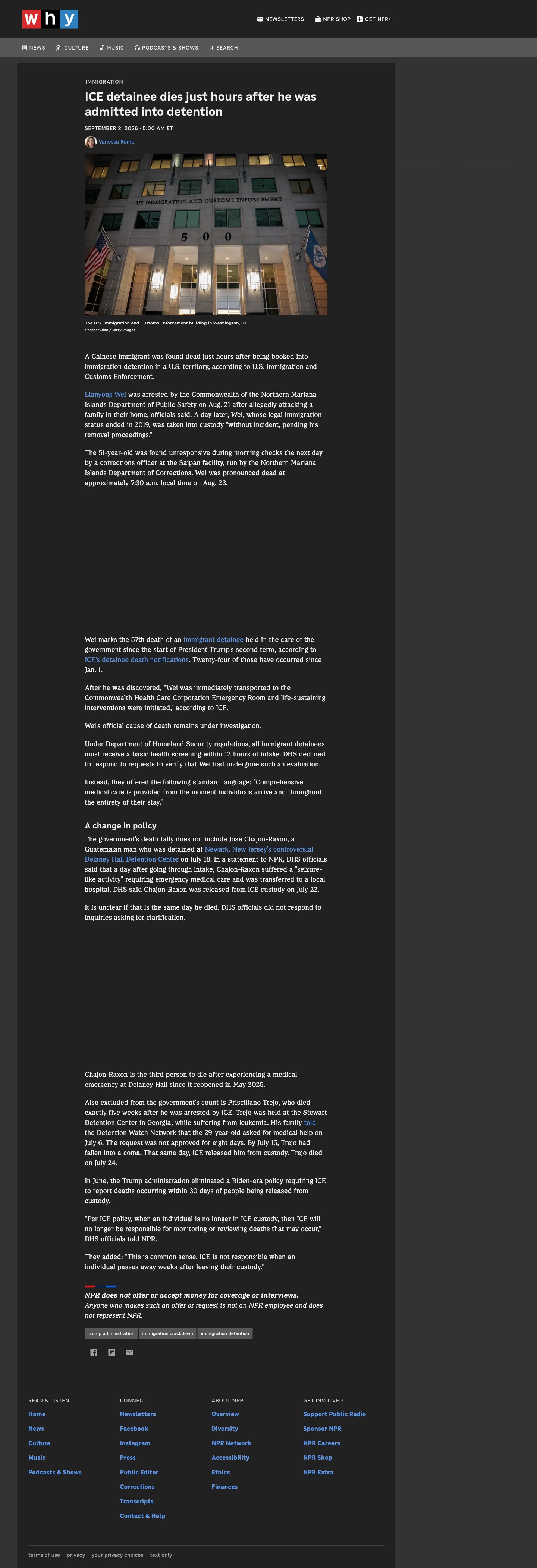
| tl;dr | An NPR report says a Chinese immigrant, Lianyong Wei, was found unresponsive and pronounced dead hours after being booked into immigration detention in Saipan, Northern Mariana Islands. ICE says the cause of death is under investigation and that emergency measures were attempted after he was discovered. The story situates the death within a broader tally of detainee deaths since the start of President Trump’s second term, notes DHS health-screening rules, and highlights a policy change limiting reporting of deaths occurring after release from ICE custody. | ||||
| deeper: | The article is largely factual and attribution-heavy, relying on ICE statements, ICE death-notification records, and DHS quotes, while also emphasizing accountability gaps (e.g., DHS declining to confirm whether a required health screening occurred). The framing is skeptical of agency transparency and foregrounds detainee-death statistics and policy changes, which can steer readers toward criticism of detention practices. Quality is strong on sourcing and context, but limited by unresolved key facts (cause of death, medical screening status) and few non-government voices in the excerpt provided. | ||||
media: | |||||
| gen: 2026/08/31:15:14 in 47.1 sec (old)bias: 6 (Center-Left) |
| type: newsquality: 74 |
| pts: 0 |

 | author: | Unknown | institution: | The Guardian | ¿porque no los dos? |
| tl;dr | The piece argues that the Trump-era Department of Homeland Security expanded or relied on a little-known legal authority to conduct surveillance and information-gathering that swept in journalists, nonprofits, and labor unions. It frames this as a serious civil-liberties threat, warning about weak oversight, broad discretion, and chilling effects on press freedom and organizing. The article emphasizes alleged secrecy and mission creep, and calls for stronger limits and transparency around DHS investigative powers. | ||||
| deeper: | The article is strongly framed and morally loaded (“outrageous”), with emphasis on rights harms and a critical posture toward Trump-era DHS. That rhetorical approach increases perceived bias, though the topic (state surveillance and oversight) is newsworthy. Quality appears solid for an explanatory/advocacy-style report: it focuses on a specific legal mechanism, describes who is affected, and highlights accountability gaps. Without seeing clear presentation of DHS’s best counterarguments or detailed primary-document excerpts in the screenshot, it reads more one-sided than purely investigative. | ||||
media: | |||||
| gen: 2026/08/25:21:21 in 2 min 25.3 sec (old)bias: 4 (Center-Left) |
| type: lolsquality: 78 |
| pts: 0 |

| gen: 2026/08/24:20:26 in 1 min 0.7 secbias: 6 (Center-Left) |
| type: colorquality: 78 |
| pts: 0 |

#immigration#voting rights#us politics#election securit#refugee policy#uscis#ice#dhs#trump#voter_fraud#refugees_safrica
Leftist
Whoa! The Trump administration drops a bomb with immigration officers
switching gears like they're in some bizarre political triathlon!
Instead of catching fraudsters, our security forces are suddenly referees
for South African refugees. It's like swapping goalkeepers mid-game!
This voter screening game plan? It's a fumble! More football, less fear!
Let's talk about truly embracing diversity and freeing that immigrant ball!
Rightist
Hold onto your hats, folks! It's a blitz in the election arena with
Trump's team putting up a wall against unlawful voters!
We're playing in the big leagues now, ensuring only the legal eagles
make the scoring shots. Immigration officers taking one for the team
to protect our democracy—no free passes on this field!
It's about batting for fair play and hitting a home run for security!

| gen: 2026/08/08:22:46 in 3 min 10.9 sec (old)bias: 4 (Center-Left) |
| type: lolsquality: 78 |
| pts: 0 |

 | author: | Alexandra Villarreal | institution: | The Guardian | ¿porque no los dos? |
| tl;dr | The Guardian reports that Haitian immigrants in the US who rely on Temporary Protected Status (TPS) could face detention and deportation after the Trump administration moved to end TPS protections. The story describes the scale of impact on Haitian families, summarizes DHS rhetoric about enforcement, and quotes advocates warning of upheaval and safety risks if people are returned to Haiti. It frames the decision as part of a broader rollback of humanitarian immigration protections and highlights community fear and uncertainty. | ||||
| deeper: | Bias leans toward immigrants and advocates: the language emphasizes fear, hardship, and humanitarian stakes, with more space for critics of the policy than for its strongest proponents. Still, it includes official DHS framing and policy context. Quality is solid: it identifies the policy change, likely affected population, and on-the-ground reaction, with attribution and quotes. Limits: the screenshot suggests less quantitative detail on enforcement outcomes and less engagement with the administration’s evidentiary claims or alternative interpretations. | ||||
media: | |||||
You made it to the bottom. Now dance!


owned and operated by: RPN Omnigalactic Insitutution as of: 2026/10/15: 15:05 in 0 ms
Enter Code
Login with Account