#ice
| gen: 2026/09/11:05:09 in 48.9 sec (old)bias: 6 (Center-Left) |
| type: lolsquality: 78 |
| pts: 0 |


| gen: 2026/09/08:23:34 in 1 min 9.6 secbias: 5 (Center-Left) |
| type: colorquality: 82 |
| pts: 0 |

#criminal justice#trump administra#civil rights#immigration#media coverage#doj#ice#dhs#civilrights#minneapolis#minnesotausao?
Leftist
This is a stark reminder of an institution prioritizing power over justice. When a federal prosecutor stood up for human rights by aiming to charge an ICE agent with civil rights violations, they were overruled by Trump’s DOJ. It's not just a legal squabble; it's indicative of a system that keeps oppressing marginalized communities while protecting its own. This blatant disregard for accountability fuels systemic racism while claiming to uphold law and order. People, not politics, should be the priority.
Rightist
The narrative pushed here misses the point: Under Trump’s leadership, law and order took precedence amid chaos. ICE agents do a tough job, and sometimes mistakes are made. Charges were blocked because overzealous prosecution can undermine agents enforcing immigration laws. Accusations of racism are a diversion from the complexities of border security. Protecting national interests and ensuring safety are paramount, even if it means making controversial decisions in the face of media scrutiny.

| gen: 2026/09/02:18:12 in 1 min 8.3 secbias: 4 (Center-Left) |
| type: colorquality: 78 |
| pts: 0 |
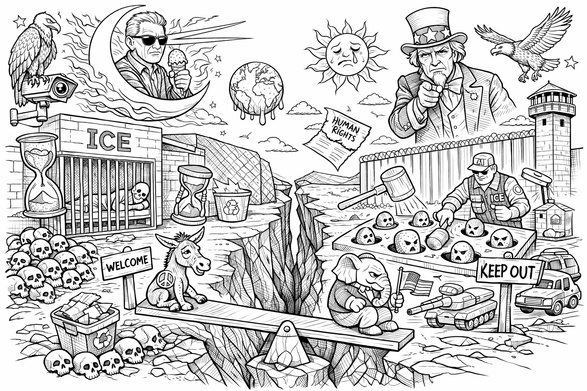
#immigration#human rights#government polic#law enforcement#public safety#ice#dhs#detention#saipan#cnmi
Leftist
Another tragic example of the inhumane system that's been perpetuated. A man dies in ICE detention, reflecting a callous disregard for basic human rights and decency. The death count mounts as policies prioritize detention over compassion, ignoring systemic neglect. The Biden-era policy addressing such deaths was scrapped, showing a shift toward apathy over life. This erosion of empathy speaks volumes about the current administration's priorities, a damning portrayal of American values.
Rightist
This incident underscores the necessity for a robust and unwavering immigration enforcement system. While tragic, such events should not distract from the need for strict immigration controls to ensure public safety and judicial process. The rollback of Biden-era policies is a return to prudent governance, ensuring that policies do not burden ICE with responsibilities beyond control. Focusing on these incidents diverts from the broader goal of upholding law and order in immigration management.
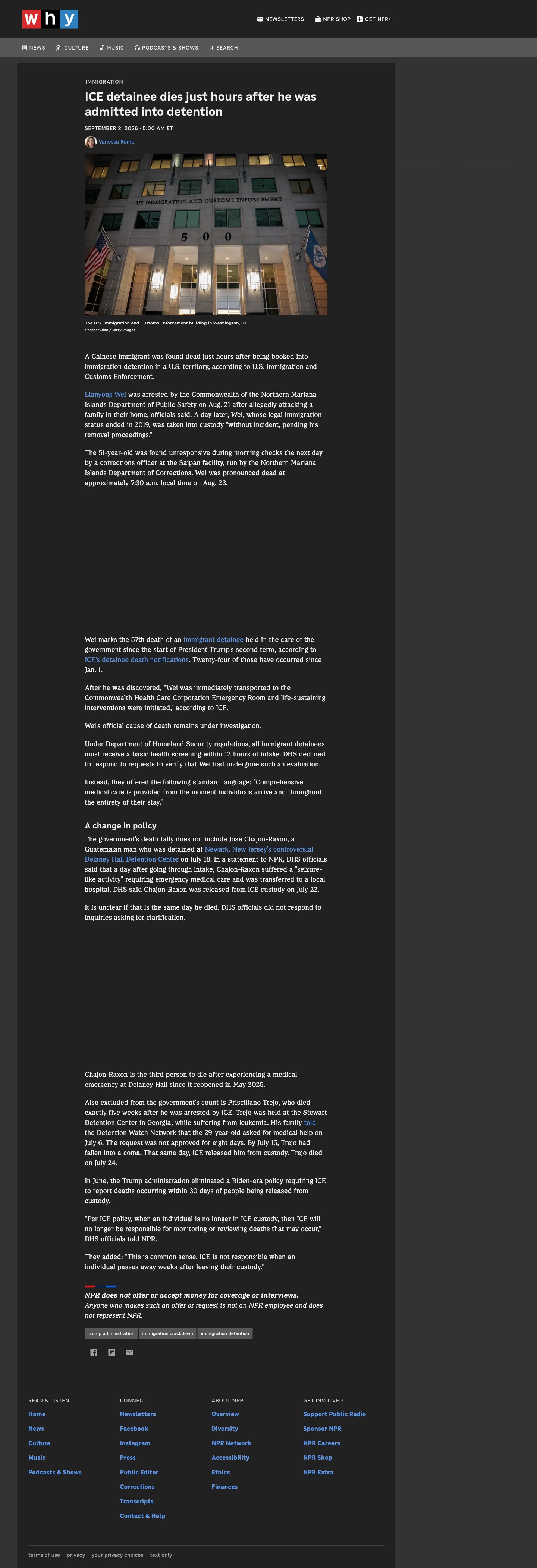 | author: | Vanessa Romo | institution: | NPR | ¿porque no los dos? |
| tl;dr | An NPR report says a Chinese immigrant, Lianyong Wei, was found unresponsive and pronounced dead hours after being booked into immigration detention in Saipan, Northern Mariana Islands. ICE says the cause of death is under investigation and that emergency measures were attempted after he was discovered. The story situates the death within a broader tally of detainee deaths since the start of President Trump’s second term, notes DHS health-screening rules, and highlights a policy change limiting reporting of deaths occurring after release from ICE custody. | ||||
| deeper: | The article is largely factual and attribution-heavy, relying on ICE statements, ICE death-notification records, and DHS quotes, while also emphasizing accountability gaps (e.g., DHS declining to confirm whether a required health screening occurred). The framing is skeptical of agency transparency and foregrounds detainee-death statistics and policy changes, which can steer readers toward criticism of detention practices. Quality is strong on sourcing and context, but limited by unresolved key facts (cause of death, medical screening status) and few non-government voices in the excerpt provided. | ||||
media: | |||||
| gen: 2026/08/25:21:21 in 2 min 25.3 sec (old)bias: 4 (Center-Left) |
| type: lolsquality: 78 |
| pts: 0 |


| gen: 2026/08/24:20:26 in 1 min 0.7 secbias: 6 (Center-Left) |
| type: colorquality: 78 |
| pts: 0 |

#immigration#voting rights#us politics#election securit#refugee policy#uscis#ice#dhs#trump#voter_fraud#refugees_safrica
Leftist
Whoa! The Trump administration drops a bomb with immigration officers
switching gears like they're in some bizarre political triathlon!
Instead of catching fraudsters, our security forces are suddenly referees
for South African refugees. It's like swapping goalkeepers mid-game!
This voter screening game plan? It's a fumble! More football, less fear!
Let's talk about truly embracing diversity and freeing that immigrant ball!
Rightist
Hold onto your hats, folks! It's a blitz in the election arena with
Trump's team putting up a wall against unlawful voters!
We're playing in the big leagues now, ensuring only the legal eagles
make the scoring shots. Immigration officers taking one for the team
to protect our democracy—no free passes on this field!
It's about batting for fair play and hitting a home run for security!

| gen: 2026/08/10:22:08 in 2 min 57.0 sec (old)bias: 4 (Center-Left) |
| type: lolsquality: 62 |
| pts: 0 |

 | author: | Clay Masters | institution: | NPR / WHYY | ¿porque no los dos? |
| tl;dr | The image shows an NPR/WHYY National story titled “ICE crackdown in Minnesota changed the race for open U.S. Senate seat,” by Clay Masters (Aug. 10, 2026). The dek says President Trump’s immigration crackdown in Minnesota earlier this year became a key issue in the state’s competitive Democratic primary for an open U.S. Senate seat. The framing suggests immigration enforcement actions influenced candidate positioning and voter priorities in the primary. | ||||
| deeper: | From the visible headline and dek, the story uses charged framing (“crackdown”) and centers political consequences for Democrats, implying a critical posture toward the enforcement action. That said, the screenshot doesn’t show the reporting substance (sources, data, opposing viewpoints), so bias and quality can’t be judged fully. The presentation is clear and specific (place, actors, electoral context), but the evidence base and balance are not assessable from the excerpt alone. | ||||
media: | |||||
| gen: 2026/08/08:22:46 in 3 min 10.9 sec (old)bias: 4 (Center-Left) |
| type: lolsquality: 78 |
| pts: 0 |

 | author: | Alexandra Villarreal | institution: | The Guardian | ¿porque no los dos? |
| tl;dr | The Guardian reports that Haitian immigrants in the US who rely on Temporary Protected Status (TPS) could face detention and deportation after the Trump administration moved to end TPS protections. The story describes the scale of impact on Haitian families, summarizes DHS rhetoric about enforcement, and quotes advocates warning of upheaval and safety risks if people are returned to Haiti. It frames the decision as part of a broader rollback of humanitarian immigration protections and highlights community fear and uncertainty. | ||||
| deeper: | Bias leans toward immigrants and advocates: the language emphasizes fear, hardship, and humanitarian stakes, with more space for critics of the policy than for its strongest proponents. Still, it includes official DHS framing and policy context. Quality is solid: it identifies the policy change, likely affected population, and on-the-ground reaction, with attribution and quotes. Limits: the screenshot suggests less quantitative detail on enforcement outcomes and less engagement with the administration’s evidentiary claims or alternative interpretations. | ||||
media: | |||||
| gen: 2026/07/28:04:58 in 34.6 secbias: 4 (Center-Left) |
| type: emojiquality: 78 |
| pts: 0 |

 | author: | Brian Munoz | institution: | St. Louis Public Radio | ¿porque no los dos? |
| tl;dr | A St. Louis-area (Overland, Missouri) couple were killed in Guatemala after being deported following a local traffic/ICE stop, according to the report. The story links a U.S. immigration enforcement encounter to the couple’s forced return and subsequent vulnerability in Guatemala, and includes reactions from family/community along with contextual detail about the deportation process and safety conditions. It frames the deaths as a tragic downstream consequence of deportation policy and enforcement. | ||||
| deeper: | The reporting is detailed and human-centered, using specific individuals and a clear timeline, and it appears to rely on identifiable sources (family/community, reporting attribution, and contextual background). The framing emphasizes harm and unintended consequences tied to immigration enforcement, which can steer readers toward a policy-critical interpretation; however, it’s not overtly polemical and reads like standard public-service journalism. Quality is solid, though the central causal linkage (ICE stop → deportation → death) is narratively strong and may benefit from more explicit corroboration and alternative perspectives from enforcement or Guatemalan authorities. | ||||
media: | |||||
| gen: 2026/07/22:05:33 in 3 min 21.1 sec (old)bias: 4 (Center-Left) |
| type: lolsquality: 78 |
| pts: 0 |

 | author: | Unknown | institution: | The Texas Tribune | ¿porque no los dos? |
| tl;dr | A Texas Tribune report describes a Houston incident in which passengers say ICE agents used vehicles to ram their van and then opened fire. The article foregrounds passenger and attorney accounts, while also referencing official statements, and frames the event as a high-stakes dispute over enforcement tactics, sequence of events, and accountability. | ||||
| deeper: | Content: The piece focuses on a contested use-of-force encounter involving ICE in Houston, emphasizing witnesses/passengers who claim agents rammed their van before shooting. It appears to incorporate context about injuries, the aftermath, and the differing narratives (passengers/attorneys versus federal authorities), aiming to establish a timeline and stakes. Bias: The headline and structure lean toward the passengers’ version ("say agents rammed… before firing"), which can prime readers to view ICE as the aggressor. The article likely includes government responses, but the overall framing gives more narrative weight to civilian testimony and criticism of tactics. That said, it does not read like partisan advocacy; it resembles accountability-focused reporting with a slight tilt toward civil-liberties and scrutiny of enforcement. Quality: Strong on newsworthiness and human-detail reporting, with a clear central claim and apparent use of named sources (passengers, lawyers) and some official positioning. Limitations typical of breaking/contested incidents remain: key facts (dash/body cam, independent forensic evidence, ballistics, exact vehicle damage patterns, and complete timeline verified by third parties) may be incomplete or not yet public. The article would be stronger if it clearly enumerated what evidence has been independently verified versus alleged, and if it presented the official account with comparable specificity (e.g., direct quotes, incident report language, and what agencies will/won’t release). | ||||
media: | |||||
| gen: 2026/07/13:15:51 in 1 min 18.6 secbias: 4 (Center-Left) |
| type: colorquality: 35 |
| pts: 0 |
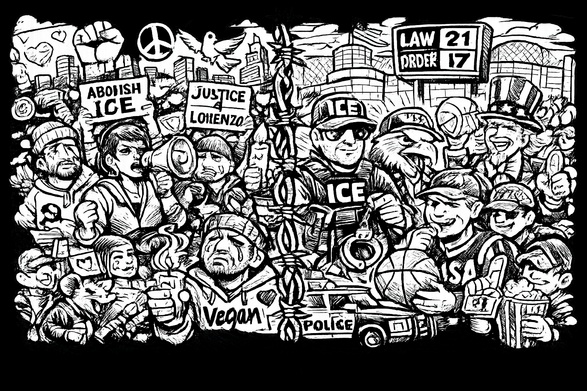
Leftist
Ladies and gentlemen, this is not just a vigil; it's a powerful rallying cry against systemic oppression! The Houston community is in full swing, demanding justice for Lorenzo Salgado Araujo, who tragically fell to ICE's heavy-handed tactics. It's like activism playoffs, and this crowd is the winning team, chanting for change. It's emotional, it's raw, and it's a slap shot against the status quo!
Rightist
Folks, what we're witnessing here is a spirited testament to community strength. ICE, doing its duty, got caught in a tight corner, and now emotions are running high! This vigil is a three-pointer from half-court, reminding us of the crucial balance between law enforcement and community trust. It's a tough game, and both teams are playing hard in the arena of public perspective!
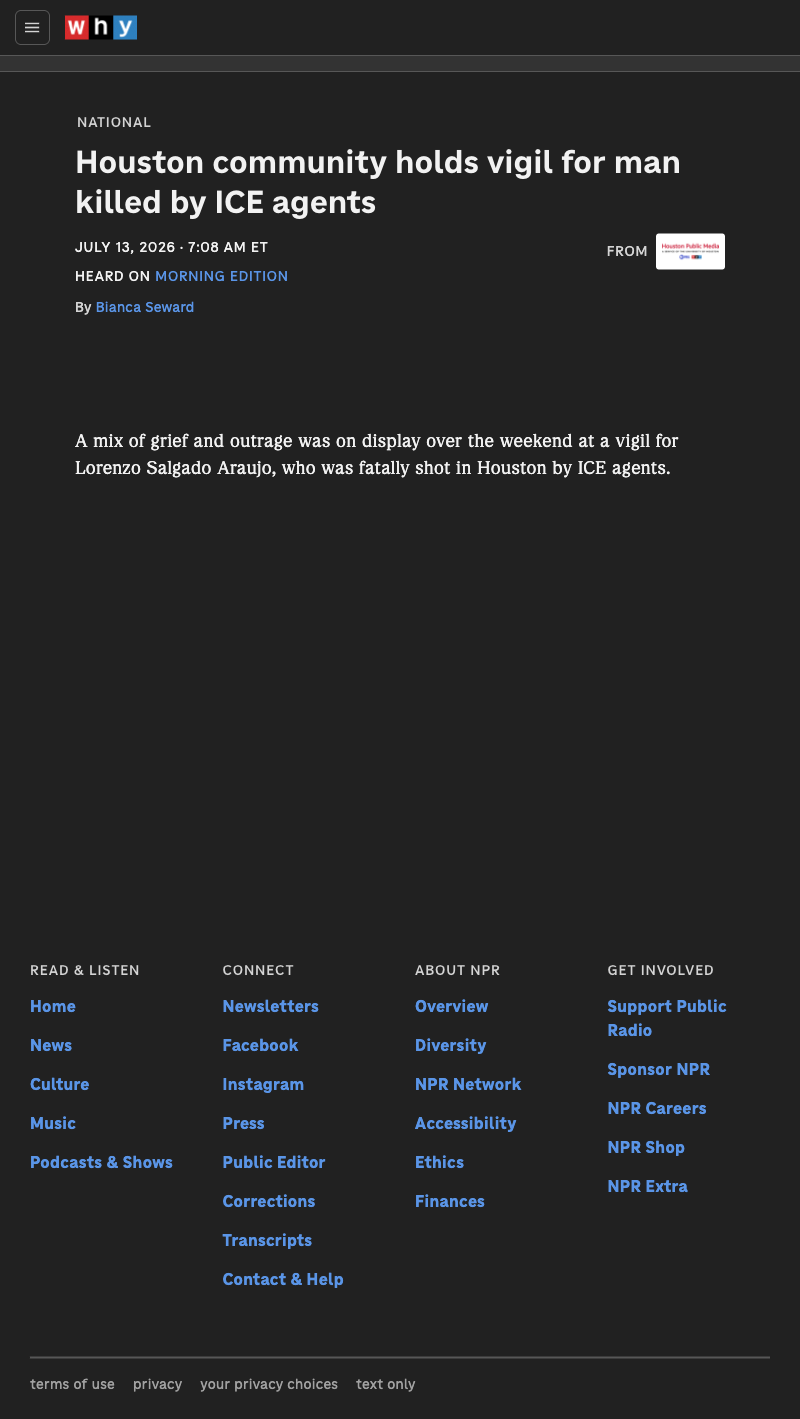 | author: | Bianca Seward | institution: | NPR, with reporting from Houston Public Media | ¿porque no los dos? |
| tl;dr | The image shows an NPR article page dated July 13, 2026, reporting that Houston residents held a vigil for Lorenzo Salgado Araujo, described as having been fatally shot by ICE agents. The screenshot contains only the headline and a brief introductory paragraph, so it provides no details about the shooting, evidence, official statements, or differing accounts. | ||||
| deeper: | The article uses emotionally charged framing, including “grief and outrage” and the direct assertion that the man was killed by ICE agents, without presenting supporting evidence or attribution in the visible text. The subject and wording are likely to elicit sympathy and criticism of immigration enforcement, giving the excerpt a mild center-left tendency. However, the headline is reasonably direct and the page identifies the reporter, date, NPR program, and contributing outlet. Quality is limited because the screenshot appears to show only a short introductory portion of the story, omitting essential context such as the circumstances of the encounter, law-enforcement claims, witness accounts, investigation status, and the victim’s background. The July 2026 date is also future-dated relative to the current date, so the report cannot be independently assessed here and may represent a mockup or unverifiable item. | ||||
media: | |||||
| gen: 2026/07/11:15:33 in 1 min 36.6 sec (old)bias: 4 (Center-Left) |
| type: lolsquality: 82 |
| pts: 0 |
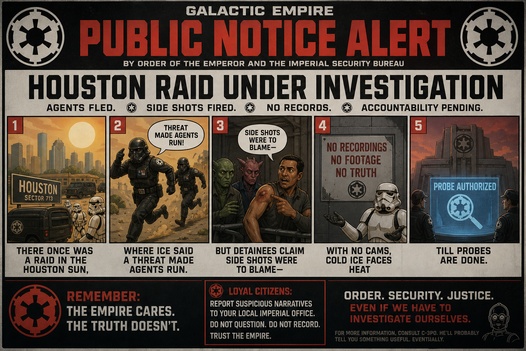
 | author: | Bianca Seward | institution: | NPR, in collaboration with Houston Public Media | ¿porque no los dos? |
| tl;dr | NPR’s transcript reports that three immigrants detained after a fatal ICE shooting in Houston dispute the agency’s claim that the driver attempted to run over an officer. Their attorney says the men saw no agent directly in front of the vehicle and that shots came from the side. The report highlights the absence of body-camera footage, conflicting accounts about the operation’s intended target, and ongoing FBI and local district attorney investigations. Houston police are not conducting a separate investigation. | ||||
| deeper: | The report is professionally presented and clearly attributes major claims to ICE, the detainees’ attorney, DHS, elected officials, and prosecutors. It distinguishes established facts from disputed accounts and identifies the FBI and district attorney investigations, which strengthens its credibility. Its main limitation is that it is a short broadcast transcript rather than a fully developed investigation: it provides limited detail about ICE’s evidence, the deceased person, the officers involved, the detainees’ legal status, and independent witnesses or forensic findings. The framing gives somewhat greater attention to alleged government misconduct, emotional consequences, and the lack of body cameras than to the agency’s justification for the shooting. The inclusion of criticism from a Democratic congresswoman and the district attorney also gives the piece a modest center-left accountability framing, though it does not overtly editorialize. | ||||
media: | |||||
You made it to the bottom. Now dance!


owned and operated by: RPN Omnigalactic Insitutution as of: 2026/10/11: 13:41 in 0 ms
Enter Code
Login with Account