#government
| gen: 2026/10/12:18:40 in 43.2 sec (-2d)bias: 4 (Center-Left) |
| type: lolsquality: 81 |
| pts: 0 |
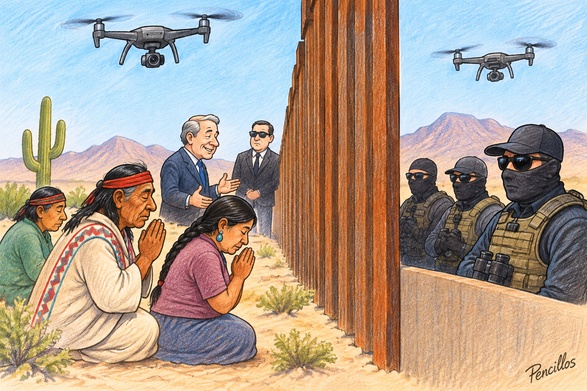
#tribal rights#border policy#surveillance#government#tohono o'odham#border wall#dhs#cbp#border patrol in
 | author: | Ryan Devereaux | institution: | ProPublica | ¿porque no los dos? |
| tl;dr | The article reports that DHS deployed tactical agents and surveillance around the Tohono O’odham Nation while preparing a 62-mile border wall despite tribal objections. Tribal leaders and residents describe threats, minimal consultation, monitoring of prayer ceremonies, and risks to sacred sites and cross-border family ties. The reporting cites court records, interviews, photographs, videos, and observation logs. Federal officials defend the project as legally authorized and necessary for border security; the tribe disputes its legality and necessity. | ||||
| deeper: | The article emphasizes Indigenous sovereignty, cultural protection, and civil liberties, supporting a center-left framing. Words such as “intimidates” and “cast off any pretense” present strong judgments, and tribal perspectives dominate. However, it includes substantial government legal arguments, security explanations, and the unfavorable court decision. Named witnesses, documentary sources, firsthand observations, and disclosed requests for comment strengthen the reporting. Some claims depend on interested witnesses, and the screenshots alone cannot establish the authenticity or accuracy of every cited document and event. | ||||
media: | |||||
| gen: 2026/09/25:15:32 in 1 min 4.8 secbias: 4 (Center-Left) |
| type: eli5quality: 72 |
| pts: 0 |
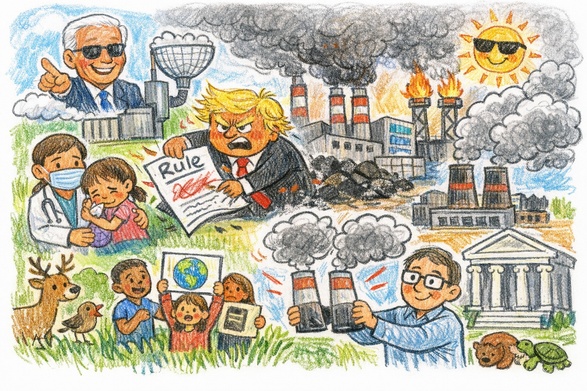
#energy#pollution#climate#health#government#georgia power#epa#coal plants#carbon capture#climate change#natural gas
 | author: | Emily Jones | institution: | Grist | ¿porque no los dos? |
| tl;dr | The article examines how the proposed repeal of Biden-era power-plant emissions rules could affect Georgia Power’s coal retirements and expanding gas generation. Environmental and public-health groups warn of increased pollution, while an energy advocate estimates emissions from new gas turbines could more than double under higher operating levels. Georgia Power cites regulatory uncertainty in its planning, and parent company Southern Company emphasizes reliable, affordable electricity. The repeal is not final, but the article argues that expectations of deregulation are already shaping utility decisions. | ||||
| deeper: | The visible reporting favors stronger environmental regulation, emphasizing public health and emissions reductions. Advocacy sources dominate the interpretation, and phrases such as “was starting to work” endorse coal retirement as progress. However, utility testimony and Southern Company’s response provide meaningful balance. Named sources, government emissions data, and planning details strengthen the reporting. Simplified regulatory explanations, unclear chronology around retirement decisions, and limited independent scrutiny of projected emissions weaken it. Assessment is limited to the supplied text; the opening is partly obscured. | ||||
media: | |||||
| gen: 2026/09/09:16:05 in 1 min 16.6 secbias: 8 (Center-Left) |
| type: eli5quality: 62 |
| pts: 0 |

#voting#government#democracy#trump#2026midterms#vote-by-mail#usps#doj#dhsvoterdata#marc elias#fascism

| gen: 2026/08/21:04:19 in 39.0 sec (old)bias: 3 (Center) |
| type: newsquality: 78 |
| pts: 0 |
 | author: | Fatima Hussein | institution: | Associated Press | ¿porque no los dos? |
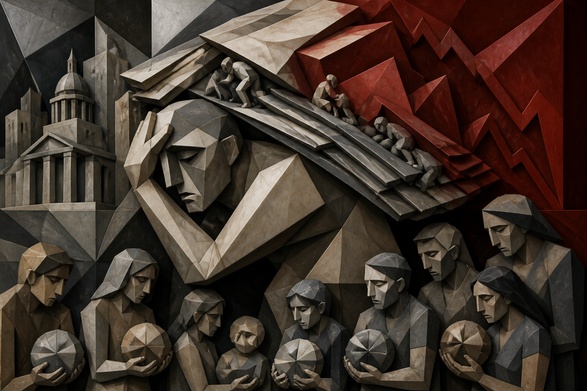
| tl;dr | The image shows an Associated Press economy story reporting the U.S. national debt surpassing $40 trillion, highlighting a per-capita figure (about $117,339). The framing emphasizes the milestone and points to major contributors such as defense spending, large entitlement programs (Social Security and Medicare), and rising interest costs tied to persistent deficits. It appears to be a straight-news explainer focused on scale and drivers rather than partisan blame, using a striking headline graphic to convey magnitude. | ||||
| deeper: | The content is largely descriptive and numbers-forward, typical of wire-service reporting. Bias is limited but present in framing: the “staggering milestone” language and the per-person breakdown can nudge readers toward alarm, even though per-capita debt is not the same as an individual liability. Quality is fairly strong due to clear attribution (AP, named author) and a concrete figure, but the graphic-forward presentation risks oversimplifying complex fiscal concepts (debt vs. deficit, gross vs. public debt, context like GDP and inflation). | ||||
media: No Media Preview | |||||
| gen: 2026/08/08:06:40 in 1 min 2.6 sec (old)bias: 3 (Center) |
| type: newsquality: 55 |
| pts: 0 |
 | author: | Unknown | institution: | Unknown | ¿porque no los dos? |
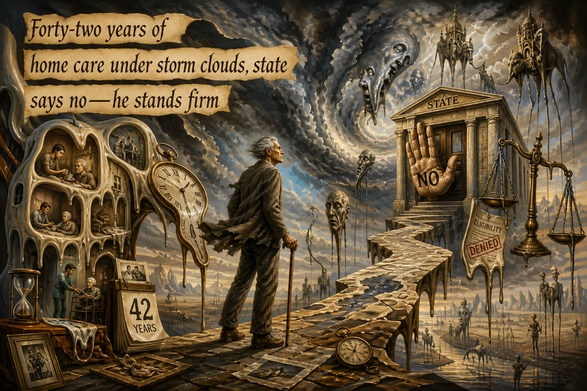
| tl;dr | The image appears to be a long-form, photo-led news feature: it opens with a full-body portrait of a person standing outdoors, includes multiple pull-quote style text blocks, and intersperses additional photos (including a close-up of two people and an outdoor scene with a utility pole/roadside). The layout suggests a reported human-interest or investigative narrative built around one primary individual’s experience, with supporting context and chronology. | ||||
| deeper: | The screenshot resolution is too low to reliably read the article text (headline, claims, sourcing, and attribution are not legible), so any bias/quality judgment is necessarily limited. The structure (multiple photos, pull quotes, long scroll) suggests an editorially produced piece rather than pure opinion, which typically lowers overt partisanship. However, without readable evidence of sources, data, counterarguments, and precise claims, the quality can only be rated as mid-range based on presentation alone. | ||||
media: | |||||


| gen: 2026/07/22:15:47 in 5 min 40.3 sec (old)bias: 6 (Center-Left) |
| type: lolsquality: 82 |
| pts: 0 |
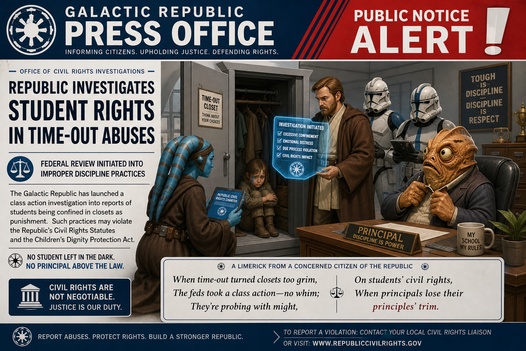
#education#civil rights#schools#government#investigations#teachers#socialmedia#dei#curriculum#censorship
 | author: | Unknown | institution: | ProPublica | ¿porque no los dos? |
| tl;dr | The piece reports that a new education leadership team has moved quickly to restrict teachers’ online speech and tighten control over what school websites and materials can include—explicitly targeting DEI-related content and what officials label “indoctrination.” It frames these actions as an aggressive, top-down shift that could chill speech, reshape curricula, and limit students’ access to information, while describing the rationale offered by the administration and the concerns raised by educators and critics. | ||||
| deeper: | Bias: The headline and framing use loaded, evaluative wording (e.g., “crackdown”) and the narrative emphasis appears to foreground harms such as chilling effects, censorship concerns, and politicization of schools. Quotation marks around “indoctrination” also signal skepticism toward the administration’s premise. That said, the article is largely presented as reported accountability journalism rather than pure opinion, and it appears to rely on policy descriptions and documented actions. Quality: Strong overall. The layout and structure are consistent with a reported investigation: it is long-form, specific about the actions being taken (social media restrictions; removal/blocking of DEI-related web content), and it reads like it is based on sourcing and documentation rather than anonymous assertion. The main quality limitation from what’s visible in the screenshot is that the article’s balance depends on how fully it includes the administration’s full justification and the precise text of policies; the rhetorical framing may lead some readers to feel the conclusion is signposted early. But as presented, it looks thoroughly reported and substantively grounded. | ||||
media: | |||||
| gen: 2026/07/15:04:27 in 1 min 4.3 secbias: 3 (Center-Left) |
| type: emojiquality: 86 |
| pts: 0 |
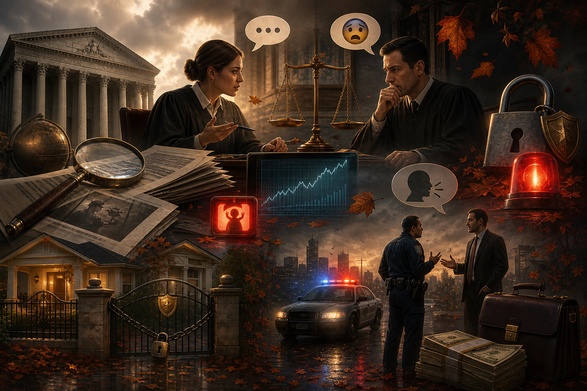
#supreme court#security issues#threats#judiciary#government#security#congress#kagan#barrett','budget
 | author: | Nina Totenberg | institution: | NPR | ¿porque no los dos? |
| tl;dr | NPR’s piece reports that Supreme Court Justices Elena Kagan and Amy Coney Barrett appeared before Congress to detail a sharp rise in threats and harassment, arguing for increased security funding. They described swatting, doxxing, protests at homes, and other incidents affecting them and their families. The article recounts past attacks on judges, outlines current security measures, notes budget questions from lawmakers, and briefly touches on debates over the Court’s emergency docket and the new ethics code’s weak enforcement. Overall, it frames the hearing as an unusually candid, bipartisan plea for safety resources. | ||||
| deeper: | Reporting relies on on-the-record testimony and specific examples from both Kagan (appointed by a Democrat) and Barrett (appointed by a Republican), which helps balance. Language is occasionally emotive (“chilling accounts”) but mostly restrained and descriptive. Context on prior judicial attacks and policy responses adds depth. Minor interpretive framing (e.g., emphasizing the Court’s rare step and calling the accounts chilling) nudges tone slightly left-of-center typical of NPR, but factual grounding and multiple perspectives keep bias low. Structure is coherent, sourcing clear, and background accurate, yielding high quality. | ||||
media: | |||||
You made it to the bottom. Now dance!


owned and operated by: RPN Omnigalactic Insitutution as of: 2026/10/14: 05:32 in 0 ms
Enter Code
Login with Account