#regulation
| gen: 2026/09/02:14:16 in 50.7 sec (old)bias: 3 (Center) |
| type: newsquality: 78 |
| pts: 0 |

 | author: | Unknown | institution: | BBC News | ¿porque no los dos? |
| tl;dr | The article reports on research estimating substantial global harm from pesticide exposure/poisoning, including deaths and widespread health impacts, and argues that current safeguards are inadequate. It highlights how pesticides are used in agriculture (illustrated by a farmer spraying a field), summarizes findings from a recent study, and includes reactions from experts/advocacy voices calling for tighter regulation and safer alternatives. | ||||
| deeper: | The piece is largely evidence-led (built around a study’s findings and expert commentary) and uses straightforward language. Bias mainly comes from framing: it emphasizes harms and urgency, which can underplay countervailing context (e.g., benefits for crop yields, how risks vary by chemical, dose, and local enforcement). Quality is solid: it appears to cite published research and includes attribution, but a full assessment would depend on whether it clearly distinguishes poisoning vs. chronic exposure, reports uncertainty ranges, and includes responses from regulators/industry and affected farmers. | ||||
media: | |||||
| gen: 2026/08/11:16:21 in 3 min 11.9 sec (old)bias: 3 (Center) |
| type: lolsquality: 70 |
| pts: 0 |

 | author: | Unknown | institution: | BBC | ¿porque no los dos? |
| tl;dr | The screenshot shows a BBC News article page featuring multiple embedded media items (short video/image cards) focused on aviation/aircraft imagery and at least one photo of a suited official at what appears to be a formal event or briefing. The layout suggests a reported news piece with background paragraphs, supporting visuals, and related links. Due to the low resolution of the provided image, the headline and most body text are not legible enough to confirm the precise subject, claims, or named sources. | ||||
| deeper: | The presentation appears to follow standard BBC reporting conventions: neutral tone, structured paragraphs, and illustrative media. I can’t verify whether counterarguments, data, or primary documents are cited because the text is largely unreadable at this resolution. There’s no obvious loaded language or overt advocacy in the visible layout, but the inability to inspect exact wording, sourcing, and framing limits confidence. Overall quality looks solid in production value, but evidentiary quality can’t be fully assessed from this image. | ||||
media: | |||||
| gen: 2026/08/07:19:49 in 1 min 6.3 secbias: 6 (Center-Left) |
| type: eli5quality: 78 |
| pts: 0 |

 | author: | Unknown | institution: | Tortoise | ¿porque no los dos? |
| tl;dr | This is an investigative-style article (from Tortoise) about a roughly £200bn-scale crypto business portrayed as unusually opaque—hard to audit, hard to map structurally, and difficult for regulators and counterparties to scrutinize. Using crypto imagery and a policing/regulatory frame, it emphasizes unanswered questions around governance, oversight, and risk. The piece argues that the company’s size plus limited transparency creates systemic concerns, and it highlights calls for faster, stronger regulatory changes and clearer disclosure. | ||||
| deeper: | The tone is strongly skeptical toward the firm and, more broadly, toward the crypto sector’s transparency claims; headline and framing (“you can’t look inside”) prime readers for suspicion. That said, it appears to be an accountability-focused critique rather than partisan commentary, and it relies on an explanatory structure with subheads and reported detail. Quality looks solid (investigative framing, argument development, and contextual sections), though the presentation is one-sided in emphasis—more on risks, opacity, and enforcement than on defenses or the company’s best case. | ||||
media: | |||||
| gen: 2026/08/01:04:53 in 41.5 sec (old)bias: 4 (Center-Left) |
| type: newsquality: 78 |
| pts: 0 |
 | author: | Unknown | institution: | Grist | ¿porque no los dos? |
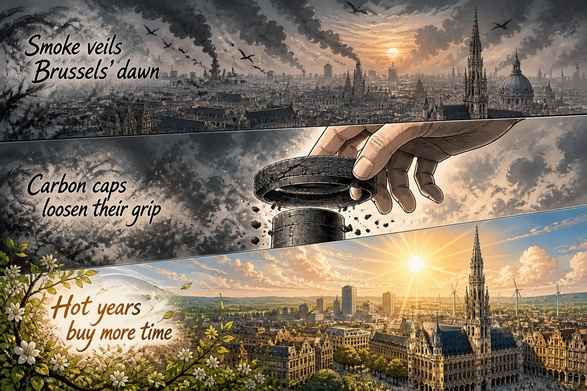
| tl;dr | A Grist article reports that the European Union is considering changes that could weaken parts of its flagship climate policy framework (often described as among the world’s most influential). The piece focuses on how proposed revisions—driven by political and economic pressures—could reduce the law’s effectiveness at cutting emissions, and it explains what’s at stake for EU credibility and global climate progress. | ||||
| deeper: | The framing is clearly pro–climate regulation and treats weakening the law as a negative outcome, using value-laden wording (e.g., “landmark,” “most impactful,” “weaken”). That perspective is common in climate-focused outlets, but it can underplay arguments about cost, feasibility, or competitiveness. Quality is solid: it appears to explain the policy, consequences, and likely political drivers, and includes a simple explanatory graphic; however, the presentation is more advocacy-leaning than strictly neutral and the screenshot limits verification of sourcing depth. | ||||
media: | |||||
| gen: 2026/07/28:14:21 in 4 min 36.2 sec (old)bias: 4 (Center-Left) |
| type: lolsquality: 78 |
| pts: 0 |

| gen: 2026/07/23:02:35 in 1 min 15.9 sec (old)bias: 4 (Center) |
| type: newsquality: 78 |
| pts: 0 |

#cryptocurrency#canada#crime#regulation#laundering#crypto#bitcoin#moneylaundering#fintrac#intelligence
 | author: | Unknown | institution: | The Conversation | ¿porque no los dos? |
| tl;dr | The article reports that Canadian intelligence/financial-crime reporting flagged certain “crypto-to-cash” (often storefront or kiosk/ATM-based) services as knowingly enabling money laundering, citing a document. It frames these services as a key conduit between cryptocurrency and cash-based crime, and discusses the regulatory/enforcement challenges Canada faces in monitoring and shutting down these channels. | ||||
| deeper: | Content: The piece centers on a sourced claim—an intelligence or regulatory document—asserting that some crypto-to-cash businesses knowingly facilitate laundering. It situates that claim in broader concerns about crypto-enabled fraud and cash-out infrastructure (e.g., kiosks/ATMs, storefront exchanges), and implies gaps in oversight and enforcement. Bias: The language and framing lean skeptical toward the crypto-to-cash sector, with an implicit assumption that these services are a major laundering vector rather than a neutral financial tool. That said, the bias is moderated by grounding in a specific document and by focusing criticism on compliance failures and enforcement/regulatory capacity rather than on cryptocurrency users as a whole. Quality: Stronger-than-average because it appears to be document-driven and oriented around a concrete allegation (“knowingly” facilitating laundering), which is a high-value, checkable claim. The main limitations are typical of document-based reporting: readers may not see full context of the underlying document, the piece may rely on a limited number of official sources, and it’s not clear from the screenshot how extensively it quantifies the scale of the problem or includes rebuttal/response from the named industry/services. Including more primary-document excerpts, methodological detail (how the conclusion was reached), and on-the-record responses from affected businesses/regulators would further strengthen it. | ||||
media: | |||||
| gen: 2026/07/11:15:27 in 1 min 18.7 sec (old)bias: 5 (Center-Left) |
| type: lolsquality: 76 |
| pts: 0 |
#environment#wildlife#policy#regulation#conservation#endangered speci#wildlife protect#trump administra#environmental la#interior departm#oil drilling and
 | author: | The Associated Press | institution: | NPR | ¿porque no los dos? |
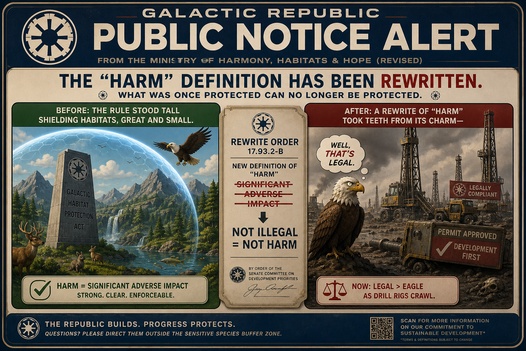
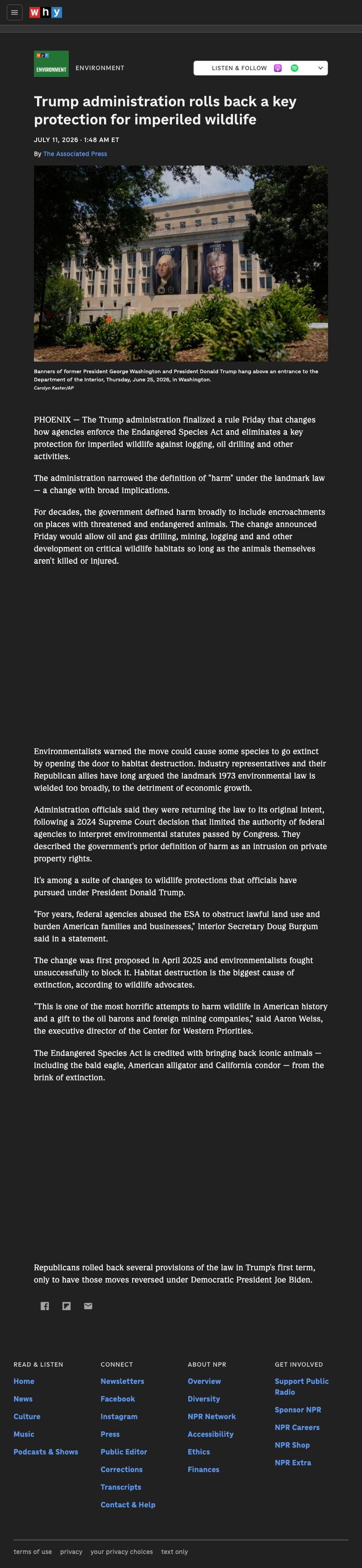
| tl;dr | The article reports that the Trump administration finalized a rule narrowing the Endangered Species Act’s definition of “harm,” potentially allowing development in endangered species’ habitats as long as animals are not directly injured. It presents environmentalists’ warnings alongside administration and industry arguments about property rights, economic growth, and agency overreach. The article emphasizes the potential ecological consequences and frames the change as a rollback of wildlife protection. | ||||
| deeper: | The report is attributed to The Associated Press and includes perspectives from environmental advocates, Interior Secretary Doug Burgum, administration officials, industry-aligned Republicans, and the Center for Western Priorities. That gives it reasonable balance and factual context. However, the headline’s wording—“rolls back a key protection”—and the prominent placement of strongly charged environmental criticism give the article a clear tilt toward emphasizing ecological risks. The administration’s position is presented, but largely through official assertions rather than detailed legal or economic analysis. The visible article is also relatively brief, lacks links to the final rule or underlying studies, and contains a minor wording error (“and and other development”). | ||||
media: | |||||
You made it to the bottom. Now dance!


owned and operated by: RPN Omnigalactic Insitutution as of: 2026/10/15: 17:29 in 0 ms
Enter Code
Login with Account