#middleeast
| gen: 2026/08/22:18:51 in 35.1 sec (old)bias: 4 (Center) |
| type: newsquality: 55 |
| pts: 0 |
| gen: 2026/08/10:02:38 in 3 min 48.9 sec (old)bias: 4 (Center) |
| type: lolsquality: 62 |
| pts: 0 |
 | author: | Unknown | institution: | France 24 | ¿porque no los dos? |
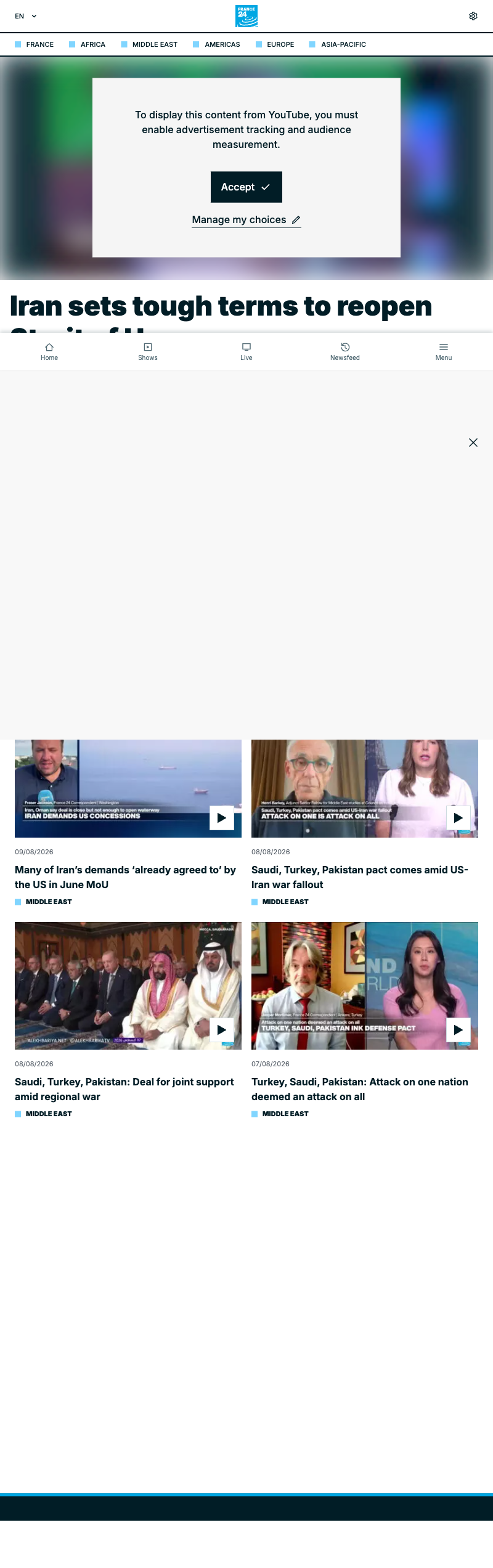
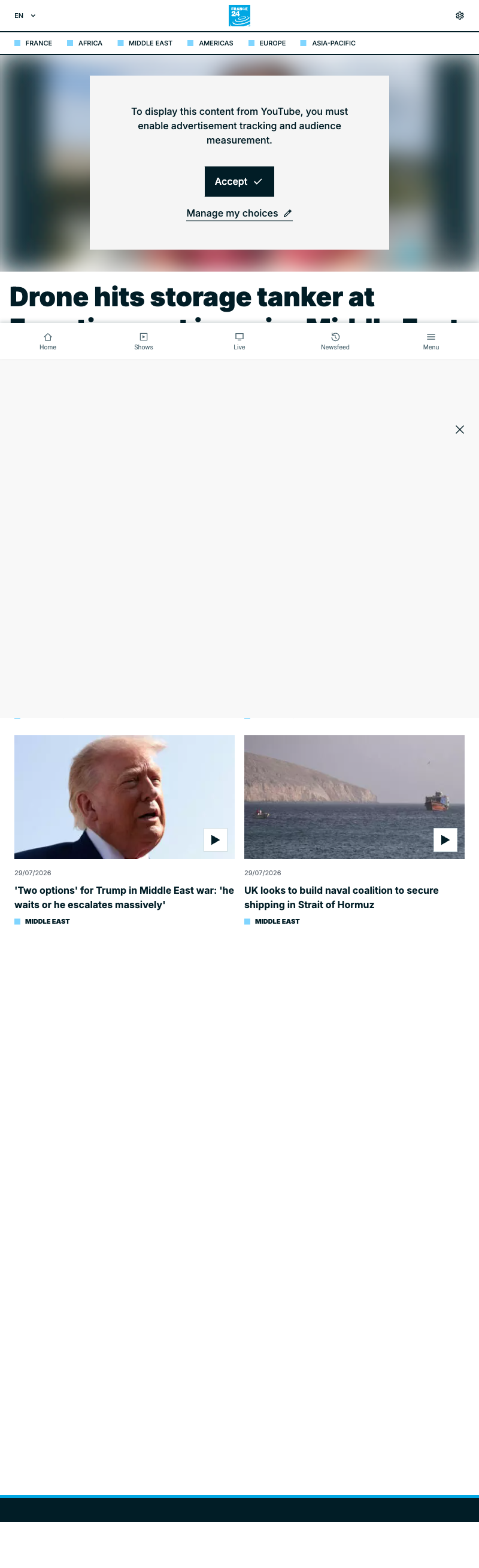
| tl;dr | The image shows a France 24 news page focused on Middle East coverage. The main visible headline reads “Iran sets tough terms to reopen …” (the remainder is cut off), with related video items about Iran demanding concessions and a Saudi–Turkey–Pakistan pact framed as fallout from US–Iran conflict dynamics. A cookie/YouTube tracking consent pop-up blocks much of the primary story text, limiting what can be verified from the screenshot alone. | ||||
| deeper: | France 24’s presentation appears largely straight-news, but wording like “tough terms” and “demands” can subtly prime readers toward a confrontational frame. The screenshot provides headlines and thumbnails but little sourcing detail (no quoted officials, documents, or context visible) because the consent overlay blocks the article/video content. Quality is therefore moderate: reputable outlet and clear topic labeling, but the available evidence here is incomplete and headline-driven. | ||||
media: | |||||
| gen: 2026/08/02:16:46 in 2 min 53.0 sec (old)bias: 6 (Center-Right) |
| type: lolsquality: 62 |
| pts: 0 |
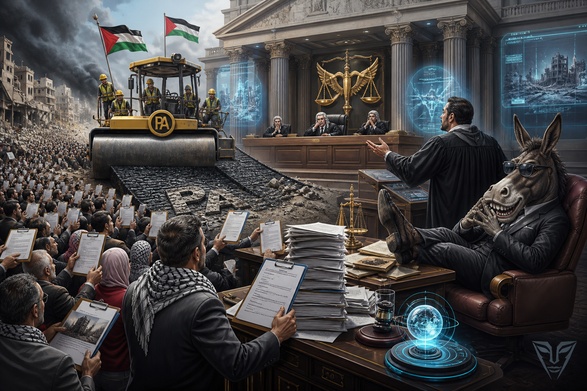
 | author: | Unknown | institution: | Jerusalem Post (via Yahoo News) | ¿porque no los dos? |
| tl;dr | A Yahoo News page displaying a Jerusalem Post article titled: “Over 8,000 plaintiffs seek to hold PA liable for October 7 massacre, war damages.” The piece reports on a large-scale legal effort by thousands of plaintiffs seeking damages and attempting to assign legal responsibility to the Palestinian Authority (PA) for harms connected to Oct. 7 and subsequent war-related losses. It frames the case as a major accountability initiative and emphasizes the scale of the claim and the alleged PA link to the attacks and damages. | ||||
| deeper: | The article’s framing strongly centers plaintiffs’ allegations and the goal of holding the PA liable, using emotionally loaded, conflict-salient phrasing (e.g., “massacre,” “war damages”) without obvious balancing context visible in the screenshot (such as the PA’s response, legal counterarguments, or limits of causation/jurisdiction). Quality is moderate: it appears to report a concrete legal development (large plaintiff count, liability claim), but based on the visible portion it leans more toward advocacy-style framing than a fully sourced, multi-sided legal explainer. | ||||
media: | |||||
| gen: 2026/07/30:05:23 in 3 min 26.0 sec (old)bias: 3 (Center) |
| type: lolsquality: 62 |
| pts: 0 |
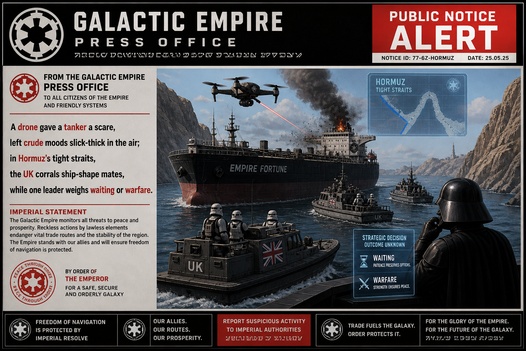
#middle-east#drones#oil#shipping#hormuz#france24#middleeast#droneattack#oilstorage#tanker#maritimesecuri1t
| gen: 2026/07/22:05:43 in 4 min 4.8 sec (old)bias: 2 (Center) |
| type: lolsquality: 78 |
| pts: 0 |
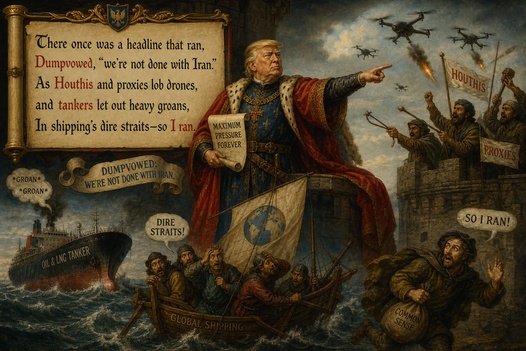
 | author: | Unknown | institution: | Unknown | ¿porque no los dos? |
| tl;dr | The piece reports on Donald Trump saying the U.S. is “not finished” attacking Iran as regional conflict escalates, and it situates his remarks alongside key developments (military actions, diplomatic reactions, and market/security implications). It relies heavily on direct quotations and attributed claims, aiming to summarize what was said and what happened rather than argue a single thesis. | ||||
| deeper: | Content: The central focus is Trump’s statement that the U.S. is “not finished” with attacks on Iran, framed within a broader, fast-moving conflict narrative. The story appears structured around (1) what Trump said, (2) what actions have occurred or are alleged, and (3) reactions/implications (regional actors, security posture, and likely economic/energy concerns). Bias: The language in the visible headline and sections is mostly descriptive and attribution-driven (quoting Trump and other officials/actors rather than asserting conclusions). The piece does use conflict-escalation framing (“conflict widens”), which is common in breaking-news coverage and can heighten urgency, but it is not overtly editorial. Any slant is mainly in story selection and emphasis—foregrounding Trump’s rhetoric and military escalation—rather than loaded adjectives or unchallenged moral claims. Quality: Stronger-than-average for a spot-news article: it appears to use multiple attributed sources, direct quotes, and sectioned context (e.g., health/threat and cost-of-war-type subsections visible in the screenshot). Limitations: it’s constrained by the breaking-news format (less space for deep verification, competing narratives, legal/strategic analysis, and historical background). It also appears to have intrusive overlays/pop-ups that interrupt reading (presentation/UX issue rather than reporting). Overall, it reads like a standard wire-style report: informative, but not deeply investigative. | ||||
media: | |||||
You made it to the bottom. Now dance!


owned and operated by: RPN Omnigalactic Insitutution as of: 2026/10/14: 08:12 in 0 ms
Enter Code
Login with Account