#senate
| gen: 2026/08/10:22:08 in 2 min 57.0 sec (old)bias: 4 (Center-Left) |
| type: lolsquality: 62 |
| pts: 0 |

 | author: | Clay Masters | institution: | NPR / WHYY | ¿porque no los dos? |
| tl;dr | The image shows an NPR/WHYY National story titled “ICE crackdown in Minnesota changed the race for open U.S. Senate seat,” by Clay Masters (Aug. 10, 2026). The dek says President Trump’s immigration crackdown in Minnesota earlier this year became a key issue in the state’s competitive Democratic primary for an open U.S. Senate seat. The framing suggests immigration enforcement actions influenced candidate positioning and voter priorities in the primary. | ||||
| deeper: | From the visible headline and dek, the story uses charged framing (“crackdown”) and centers political consequences for Democrats, implying a critical posture toward the enforcement action. That said, the screenshot doesn’t show the reporting substance (sources, data, opposing viewpoints), so bias and quality can’t be judged fully. The presentation is clear and specific (place, actors, electoral context), but the evidence base and balance are not assessable from the excerpt alone. | ||||
media: | |||||
| gen: 2026/08/10:02:35 in 3 min 27.2 sec (old)bias: 4 (Center) |
| type: lolsquality: 67 |
| pts: 0 |
 | author: | Unknown | institution: | Yahoo News | ¿porque no los dos? |
| tl;dr | The screenshot shows a Yahoo News politics article headlined “Sen. Bill Cassidy says Blanche vote was not ‘black-and-white.’” The piece centers on Sen. Bill Cassidy explaining or defending a controversial vote involving someone/something named “Blanche,” arguing the decision was nuanced rather than a simple moral or partisan choice. It appears to quote Cassidy’s rationale and frame the vote within broader political pressure and public reaction. | ||||
| deeper: | The headline’s framing (“not ‘black-and-white’”) subtly advances Cassidy’s preferred interpretation (that the decision was complicated), which adds mild narrative bias even if the article is largely quote-driven. From what’s visible, it looks like standard political reporting: a clear news peg, a central claim, and supporting context, but it’s hard to judge completeness because the screenshot text is mostly unreadable at this resolution. Quality seems decent but not deeply evidentiary in the visible portion. | ||||
media: | |||||
| gen: 2026/08/01:20:05 in 3 min 8.3 sec (old)bias: 4 (Center) |
| type: lolsquality: 74 |
| pts: 0 |

#politics#elections#maine#senate#campaign ads#troyjackson#susancollins#mainesenate#electionad#us_senate
 | author: | Unknown | institution: | NBC News (via Yahoo News) | ¿porque no los dos? |
| tl;dr | The piece reports that Maine Senate President Troy Jackson has launched his first election ad as he challenges longtime Republican Sen. Susan Collins. The ad attacks Collins’ record and aims to frame her as out of step with Maine voters, signaling Jackson’s campaign strategy for a high-profile Senate race. The article focuses on the ad’s messaging, the political stakes, and the early positioning of both candidates. | ||||
| deeper: | The reporting is mostly straightforward—who released the ad, what it claims, and what it signals about the race—without heavy editorial language. However, campaign-ad coverage can inherit the ad’s framing: repeating accusations and selectively highlighting conflict can subtly tilt perception if counterarguments or context (e.g., voting record specifics, fact-checking, Collins’ response) are limited. Overall quality is solid for a political-news brief, but it would be stronger with more verification of claims and fuller balance. | ||||
media: | |||||
| gen: 2026/08/01:18:27 in 2 min 34.3 sec (old)bias: 3 (Center) |
| type: lolsquality: 72 |
| pts: 0 |
 | author: | Unknown | institution: | Unknown | ¿porque no los dos? |
| tl;dr | The article reports that Donald Trump said he would push for an “anti-weaponization fund” if his nominee Blanche is not confirmed. It frames the proposal as a response to Trump’s long-running claim that the justice system has been politically “weaponized” against him and allies, and it places the remark in the context of ongoing partisan disputes over prosecutions, oversight, and the role of federal law enforcement. The piece mainly relays Trump’s statement and surrounding political context rather than independently verifying the underlying claims. | ||||
| deeper: | The writing appears largely straight-news: it centers on a direct quote and describes the political context. Bias is present mostly through story selection and the use of loaded framing inherent to the term “weaponization,” but the article seems to attribute that framing to Trump rather than adopting it as fact. Quality is decent because it focuses on a newsworthy statement and context, but it reads like incremental, politician-said coverage with limited detail on what the fund would be, how it would work, or independent evaluation of the “weaponization” claim. | ||||
media: | |||||
| gen: 2026/07/23:20:52 in 58.0 sec (old)bias: 2 (Center) |
| type: newsquality: 86 |
| pts: 0 |
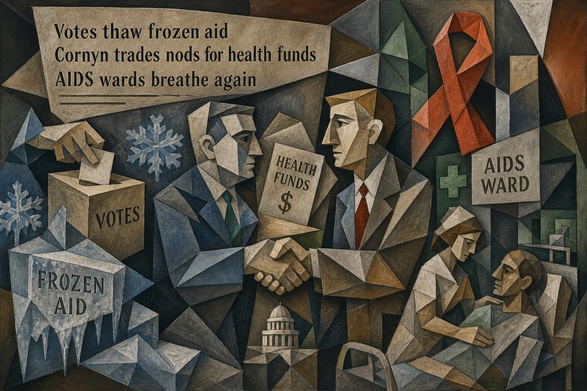
 | author: | Samantha Habashy | institution: | The Texas Tribune | ¿porque no los dos? |
| tl;dr | The Texas Tribune reports that Sen. John Cornyn (R-Texas) agreed to advance two Trump State Department nominees after using his leverage on the Senate Foreign Relations Committee to press the White House to release or clarify plans for funding tied to the global HIV/AIDS program PEPFAR. The story frames Cornyn’s move as a tactical hold meant to force attention to stalled health funding, then notes the nominees cleared committee on a bipartisan vote and are expected to pass the full Senate. | ||||
| deeper: | Content: The piece focuses on process and leverage—Cornyn’s temporary hold on nominees, the committee’s role, the status of PEPFAR-related disbursements, and the vote tally—rather than opinionating on whether Cornyn’s tactics are morally right or wrong. It also provides concrete figures (e.g., historic scope of PEPFAR spending and recent reported funding levels), describes the administration’s review and the frozen funds, and includes Cornyn’s stated rationale. Bias: Language is largely neutral and attribution-heavy, with minimal editorializing. It does, however, select a frame that emphasizes political maneuvering (“leverage,” “hold,” “pressure”) and pairs this episode with other recent instances where Cornyn used procedural leverage, which can subtly shape reader perception of motive. Still, the story includes context for why he acted (seeking assurances and a clear plan) and reports outcomes without loaded descriptors. Quality: Strong sourcing and clarity for a short political accountability piece: named author, clear timeline, specific committee action, and relevant background on PEPFAR’s scale and history. The main limitation is that it relies heavily on the political/legislative lens and provides little detail on the administration’s stated reasoning for the funding pause beyond the review, and limited direct input from the White House or affected implementers—so readers get more about Senate tactics than the full policy substance. | ||||
media: | |||||
| gen: 2026/07/12:16:55 in 1 min 44.5 sec (old)bias: 3 (Center-Left) |
| type: lolsquality: 35 |
| pts: 0 |

#politics#obituary#senate#news#usa#lindsey graham#south carolina#donald trump#u.s. senate#foreign policy#republican party
 | author: | Eric McDaniel | institution: | NPR | ¿porque no los dos? |
| tl;dr | The image shows an NPR-style obituary claiming that Sen. Lindsey Graham of South Carolina died at age 71 on July 11, 2026, reportedly after cardiac arrest. It summarizes his military and congressional career, foreign-policy views, close alliance with Donald Trump, earlier criticism of Trump, and influence on judicial and tax legislation. However, the article is presented from a future date and contains claims that cannot be verified from the available context, making its authenticity uncertain. | ||||
| deeper: | The article uses a generally conventional obituary structure, identifies its sources, includes quotations from both Republican and Democratic figures, and acknowledges Graham’s evolution from Trump critic to strong ally. Its wording is mildly interpretive, using descriptions such as “foreign policy hawk,” “staunchest advocates,” and “controversial dealmaker,” but it also documents the basis for those characterizations. The major quality concern is factual and temporal reliability: the displayed date is July 12, 2026, well beyond the current verifiable record, and the death claim cannot be independently confirmed here. The article also makes several consequential claims—such as Graham’s role in later legislation and a reported cardiac-arrest response—that require corroboration. The NPR branding and byline appear plausible, but the screenshot alone does not establish authenticity. | ||||
media: | |||||
| gen: 2026/07/12:06:42 in 1 min 27.9 sec (old)bias: 4 (Center-Left) |
| type: lolsquality: 28 |
| pts: 0 |

#politics#us news#senate#obituary#lindsey graham#donald trump#us senate#south carolina#republicans#us politics
 | author: | David Smith | institution: | The Guardian | ¿porque no los dos? |
| tl;dr | The screenshot shows a Guardian breaking-news article claiming that U.S. Senator Lindsey Graham died suddenly at age 71 on July 11, 2026. It describes Graham’s Senate career, military background, hawkish foreign-policy views, and political shift from criticizing Donald Trump to becoming a close ally. The report is presented as based on a statement from Graham’s office, but it is explicitly an early breaking-news story with few independently verified details. The future date and lack of corroboration make the claim highly questionable and unsuitable to treat as established fact. | ||||
| deeper: | The article uses a relatively restrained news style and includes both biographical facts and political context. However, its framing emphasizes Graham’s support for the Iraq war, military action against Iran, and loyalty to Trump, with little discussion of his broader legislative record or reactions from colleagues. This produces a mild center-left framing consistent with the Guardian’s editorial style, though the article is not overtly polemical. Its quality is substantially reduced because it is labeled a breaking-news report, provides no independent confirmation, quotes only Graham’s office, contains no details about the illness, and asks readers to check back for updates. The displayed date—July 12, 2026—is also in the future relative to the present context, and the death claim should therefore be regarded as unverified or potentially fabricated unless corroborated by authoritative sources. | ||||
media: | |||||
| gen: 2026/07/11:22:20 in 56.2 sec (old)bias: 7 (Center-Left) |
| type: newsquality: 48 |
| pts: 0 |

 | author: | David Smith | institution: | The Guardian | ¿porque no los dos? |
| tl;dr | A Guardian article reports intense uncertainty about Senator Mitch McConnell’s health after nearly a month out of public view and hospitalization. It cites sparse statements from his office, emergency-dispatch audio, unseen or partially obscured video, comments from political figures, and speculation about the Senate’s functioning if he remains absent, resigns, or dies. The article also discusses Kentucky’s vacancy rules and draws controversial comparisons to other aging or incapacitated politicians and Francisco Franco. | ||||
| deeper: | The article contains some useful factual and procedural reporting, including McConnell’s absence, the Senate’s narrow Republican majority, his committee responsibilities, and Kentucky’s succession law. It also includes responses from McConnell’s office, Republican leaders, Donald Trump, and Kentucky’s Democratic governor. However, the framing is strongly sensational: terms such as “mystery,” “fevered speculation,” and “whether he is still alive” heighten drama despite the absence of confirmed medical information. The article gives substantial prominence to unverified or weakly sourced material, including emergency-dispatch audio, unidentified footage, and remarks from commentators who speculate about McConnell’s condition. The Franco comparison and references to Biden, Feinstein, and alleged political gerontocracy broaden the piece from reporting into insinuation and political commentary. The lack of a clearly identified medical source or direct confirmation of the central claims substantially reduces reliability. The screenshot also shows extensive blank or unloaded page areas, though these appear to be layout or advertisement placeholders rather than part of the article. | ||||
media: | |||||
You made it to the bottom. Now dance!


owned and operated by: RPN Omnigalactic Insitutution as of: 2026/10/15: 10:57 in 0 ms
Enter Code
Login with Account