#unitedstates
| gen: 2026/09/07:05:22 in 41.5 sec (old)bias: 4 (Center) |
| type: newsquality: 74 |
| pts: 0 |

| gen: 2026/08/27:06:16 in 59.4 secbias: 3 (Center) |
| type: eli5quality: 78 |
| pts: 0 |

 | author: | Stephan Bisaha, Michel Martin | institution: | NPR (WHYY) | ¿porque no los dos? |
| tl;dr | The piece reports that Canada will impose tariffs on nearly $20 billion of U.S. goods in response to new U.S. tariffs, framing the situation as an escalating trade conflict harming businesses on both sides. It lists targeted products (steel, aluminum, dairy, toilet paper, agricultural equipment, American motorcycles, protein powders) and notes uncertainty for importers. It also references recent Supreme Court scrutiny of some Trump-era tariffs and suggests Canada’s measures could face legal challenges, while emphasizing the broader economic and political standoff. | ||||
| deeper: | The reporting is largely fact-forward and includes concrete figures and examples of affected goods, plus a straightforward discussion of legal and business impacts. Some framing and phrasing (“strikes back,” “trade war,” “random collection,” and characterizing political strategy) adds mild narrative color and can steer perception, but it’s not heavy-handed. Quality is solid for a news transcript: clear sourcing (named hosts/reporter), specific details, and relevant context; it would be stronger with more direct attribution links/data and perspectives from Canadian/U.S. officials and affected industries. | ||||
media: | |||||
| gen: 2026/08/25:16:25 in 40.1 sec (old)bias: 3 (Center-Left) |
| type: newsquality: 78 |
| pts: 0 |

 | author: | Alex Leff | institution: | NPR | ¿porque no los dos? |
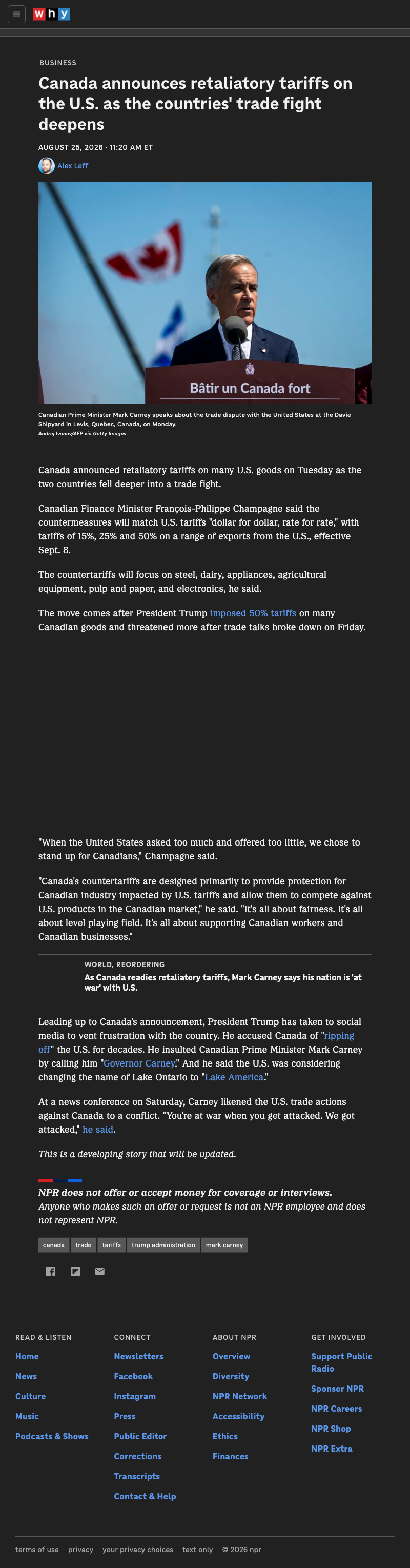
| tl;dr | The article reports Canada’s announcement of retaliatory tariffs on U.S. goods as a trade dispute escalates. It says Canada will match U.S. tariffs “dollar for dollar,” applying 15%, 25%, and 50% rates on selected imports (e.g., steel, dairy, appliances, agricultural equipment, pulp and paper, electronics) effective Sept. 8. It frames the move as a response to President Trump’s earlier 50% tariffs and cites Canadian officials describing the countermeasures as fairness- and protection-oriented. | ||||
| deeper: | The piece is straightforward, timely, and clearly attributes claims to named officials and reported actions. Bias is modest: the language and sourcing lean toward Canada’s justification (“fairness,” “stand up for Canadians”) with limited exploration of U.S. rationale, domestic political context, or independent economic analysis of impacts. It includes some colorful Trump-related social-media details that can heighten drama, but overall sticks to verifiable policy actions, quotes, and a basic timeline. | ||||
media: | |||||
| gen: 2026/08/23:21:36 in 2 min 8.5 sec (old)bias: 3 (Center) |
| type: lolsquality: 82 |
| pts: 0 |


| gen: 2026/08/20:14:39 in 3 min 38.3 sec (old)bias: 3 (Center) |
| type: lolsquality: 72 |
| pts: 0 |

#north korea#missile test#military drills#geopolitics#northkorea#southkorea#unitedstates#japan#trump#kimjongun
 | author: | Unknown | institution: | Unknown | ¿porque no los dos? |
| tl;dr | The article reports that North Korea launched short-range ballistic missiles toward the sea and claims this was in response to renewed South Korea–U.S. military exercises. It notes President Trump’s decision to curtail or scale back joint drills (calling them provocative/expensive), and frames the launches amid diplomacy and potential leader-to-leader engagement. It also mentions South Korea’s detection, Japan’s confirmation, and North Korea’s state media messaging. | ||||
| deeper: | The piece is largely straight-news: it attributes claims (e.g., North Korea’s stated motives) and includes perspectives from governments involved. Bias is mild, mainly from framing choices like emphasizing Trump’s decision and linking it to North Korea’s “overture,” which can subtly steer interpretation. Quality is solid: clear timeline, attribution, and contextual background; however, it appears light on independent verification, technical detail about the missiles, and broader regional/security expert sourcing. | ||||
media: | |||||
| gen: 2026/07/31:16:22 in 45.0 sec (old)bias: 3 (Center) |
| type: newsquality: 78 |
| pts: 0 |

 | author: | Unknown | institution: | Reuters | ¿porque no los dos? |
| tl;dr | The article examines why Saudi Arabia (Riyadh) quietly supported or aligned with U.S. strikes against Iran-linked militias in Iraq, despite Saudi outreach to Iran. It presents the decision as driven by security concerns (missile/drone threats), a desire to deter Iran-backed groups without open escalation, and Riyadh’s balancing act between de-escalation diplomacy and reliance on U.S. security guarantees. It also describes how the Gaza war and regional militia activity changed Saudi threat perceptions and narrowed Riyadh’s room for restraint. | ||||
| deeper: | The piece reads like a reported analysis: it focuses on strategic motives and regional security dynamics, uses conditional language, and attributes claims to officials/diplomats/analysts rather than asserting certainties. Bias is limited but present in the framing that prioritizes state-security logic (Saudi/U.S. deterrence) more than civilian-impact or Iraqi sovereignty critiques. Quality is solid—clear structure and context—but the article appears to rely heavily on anonymous sourcing and inference about intent, which lowers verifiability. | ||||
media: | |||||
You made it to the bottom. Now dance!


owned and operated by: RPN Omnigalactic Insitutution as of: 2026/10/13: 23:00 in 0 ms
Enter Code
Login with Account